JavaScript code
15.03.2023

Managing remote data in React applications using React Query

React Query

React Query is a library that simplifies the task of fetching, caching, and updating data in React applications. It is designed to work seamlessly with React, providing a set of hooks and utilities that enable developers to manage data without the usual complexity that comes with it.

In this blog post, we will discuss the main features and benefits of React Query. Also, how these features and benefits can improve the development experience of React applications.

Features of React Query

  1. Data fetching: React Query provides a set of hooks and utilities that enable developers to fetch data from various sources, such as REST APIs, GraphQL endpoints, and local storage. The library handles the complexities of data fetching, such as caching, refetching, and error handling, allowing developers to focus on building the UI components.
  2. Caching: React Query provides a cache that stores data in memory, enabling fast and efficient data retrieval. The cache is automatically updated when new data is fetched, ensuring that the UI always displays the latest data.
  3. Query composition: React Query allows developers to compose queries, enabling them to fetch data from multiple sources and combine the results. This feature eliminates the need for complex data merging logic, making it easier to manage data in complex applications.
  4. Real-time updates: React Query supports real-time updates, allowing developers to receive new data as soon as it becomes available. This feature is particularly useful in applications that require real-time data, such as chat apps, stock market trackers, and sports scoreboards.
  5. Pagination: React Query provides a pagination feature that enables developers to fetch data in smaller chunks, improving the performance of applications that display large datasets.

Benefits of React Query

  1. Improved developer productivity: React Query simplifies the task of managing data in React applications, enabling developers to focus on building UI components. The library handles the complexities of data fetching, caching, and updating, reducing the amount of boilerplate code that developers need to write.
  2. Faster application performance: React Query’s caching and pagination features improve the performance of applications that display large datasets, enabling faster data retrieval and rendering.
  3. Better user experience: React Query’s real-time updates feature enables applications to display the latest data as soon as it becomes available, improving the user experience of real-time applications.
  4. Reduced network traffic: React Query’s caching feature reduces the amount of network traffic by storing data in memory and only fetching new data when necessary.
  5. Easy integration with other libraries: React Query can be easily integrated with other React libraries, such as Redux and Apollo, enabling developers to build complex applications with ease.

Examples

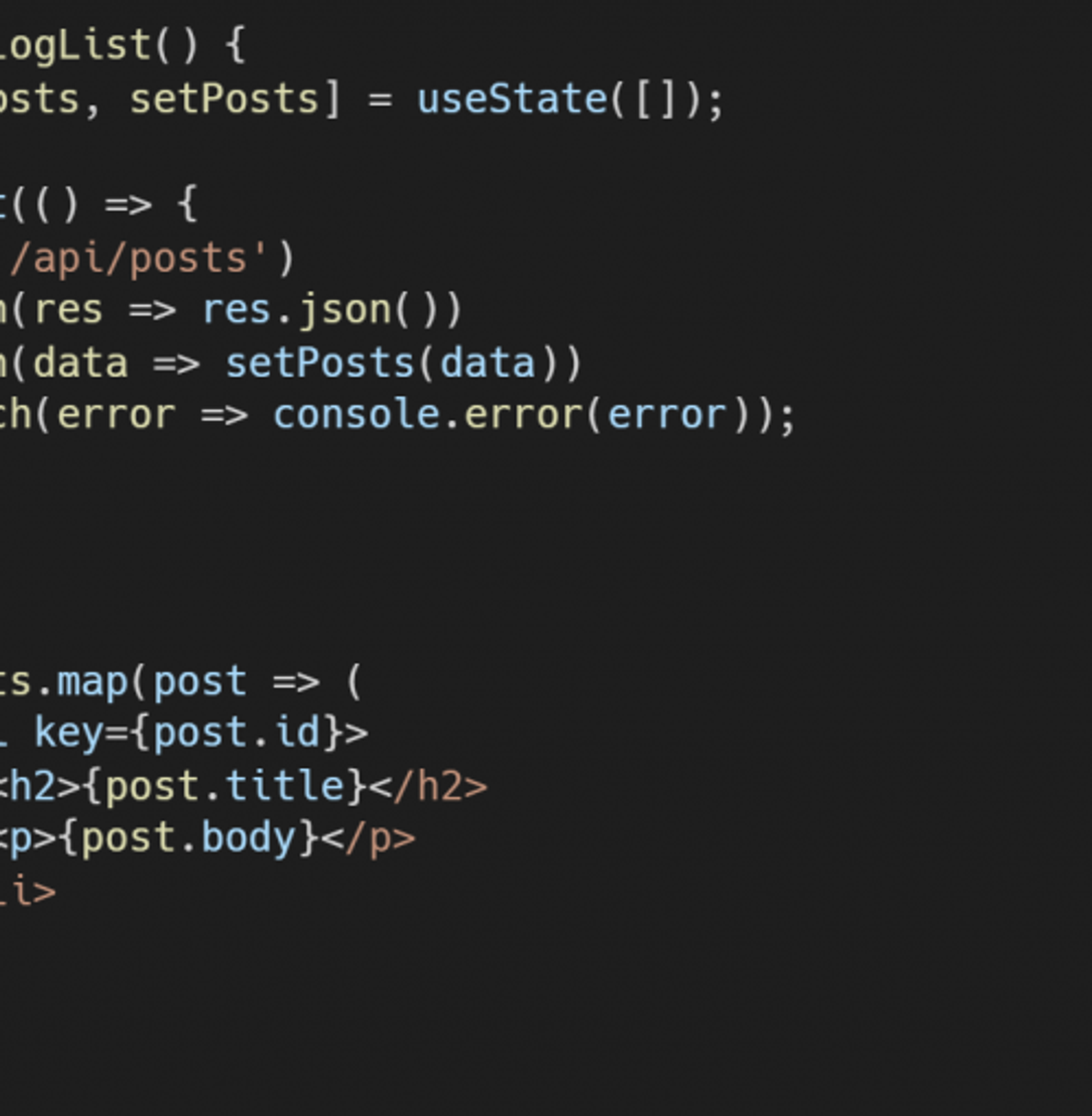
Let’s say we have a simple React component that displays a list of blog posts fetched from an API:

React JavaScript code example

This component makes an API request using fetch and updates the state of the component with the fetched data. However, this code is missing some important features, such as caching, error handling, and refetching. If we want to add these features, we have to write additional code:

React JavaScript code example

As you can see, the code becomes more complex when we add features such as error handling and refetching. This is where React Query comes in. With React Query, we can simplify this code and add more features:

React JavaScript code example

As you can see, the code is much simpler with React Query. We use the “useQuery” hook to fetch data from the API and manage the state of the component. React Query handles the caching, error handling, and refetching for us. Thus, it is easier for us to manage data in our React applications. Additionally, React Query provides other features such as real-time updates and pagination. These features can further simplify data management in complex applications.

Summary

In conclusion, React Query is a powerful library that simplifies the task of managing data in React applications. Its features (data fetching, caching, query composition, real-time updates, and pagination) enable developers to build faster and more responsive applications with ease. Its benefits, such as improved developer productivity, faster application performance, better user experience, and easy integration with other libraries, make it an excellent choice for building complex applications.

About The Author

Ivan Vanelov is a Front End Developer at Droxic, working on various projects for different clients. Ivan is also working on a side project, related to property and facility management. He is also passionate about mountain hiking and sports.

Managing remote data in React applications using React Query